Ask a property manager what actually moves the needle on leasing in 2026, and the answer is no longer the fitness center. In the NMHC and Grace Hill Renter Preferences Survey of more than 172,000 renters across 4,220 communities, 90% of respondents said they were interested in - or would not rent without - high-speed internet, ranking it just behind air conditioning and an in-unit washer/dryer. And 87% called having internet available immediately on move-in "very important" or "absolutely essential."
That second number is the hard one. A resident can wait a week for a gym fob. Nobody wants to wait a week - or sit through an installer appointment - to get online in their own home. This is the problem multi-dwelling unit (MDU) WiFi exists to solve: one property-wide network that behaves, for every resident of an apartment building, condominium, student housing block, or senior living community, like a private home network that was working before they picked up the keys.
Why Has WiFi Become a Make-or-Break Amenity for Apartment Buildings?
Connectivity has quietly moved from "utility the resident arranges" to "amenity the property competes on." Beyond the headline numbers above, NMHC's research found roughly two-thirds of renters interested in pre-installed WiFi, a share that keeps climbing with each survey cycle. The drivers are familiar:
- Remote and hybrid work made residential bandwidth a livelihood issue, not a leisure one
- Streaming, gaming, and video calls raised the floor on what "good enough" means in every unit
- Smart-building systems - locks, thermostats, leak sensors, package rooms - need dependable connectivity of their own
- Day-one expectations: a move-in weekend with no internet now reads as a property failure, not an ISP delay
For owners and operators, the upside of meeting that expectation is a stickier lease and a genuine differentiator. The catch is that the two traditional delivery models both fail at it.
What's Wrong With the Old Ways of Delivering Apartment WiFi?
Model one: every unit is its own ISP account. Each resident orders service, waits for activation, and plugs in their own router. The property gets no revenue, no visibility, and no coverage in hallways, gyms, or courtyards - but it does get the radio-frequency chaos of a hundred consumer routers shouting over each other through concrete walls. Day-one internet is impossible by design, because the clock starts when the resident signs up.
Model two: one building-wide network with a shared password. This is how many properties first "solve" WiFi, and it trades the activation problem for a security problem. A single passphrase shared across hundreds of strangers is only as safe as the least careful person who has it. Everyone sits on one flat network where devices can see each other; nothing ties traffic to a unit; and when the passphrase leaks - it always leaks - rotating it means re-onboarding every resident at once. We walk through the underlying weakness in our PSK-to-802.1X migration playbook, and it applies to a 200-unit building even more than to an office.
The Shared-Password Trap
A passphrase on the leasing-office whiteboard is a credential with no owner. It can't be revoked for one person, it can't attribute abuse to a unit, and it puts a former resident and a current one on the same network with equal standing. If your building WiFi can't answer "who is this device?", it isn't an amenity yet - it's a liability with good signal strength.
How Does Managed MDU WiFi Give Every Resident a Private Network?
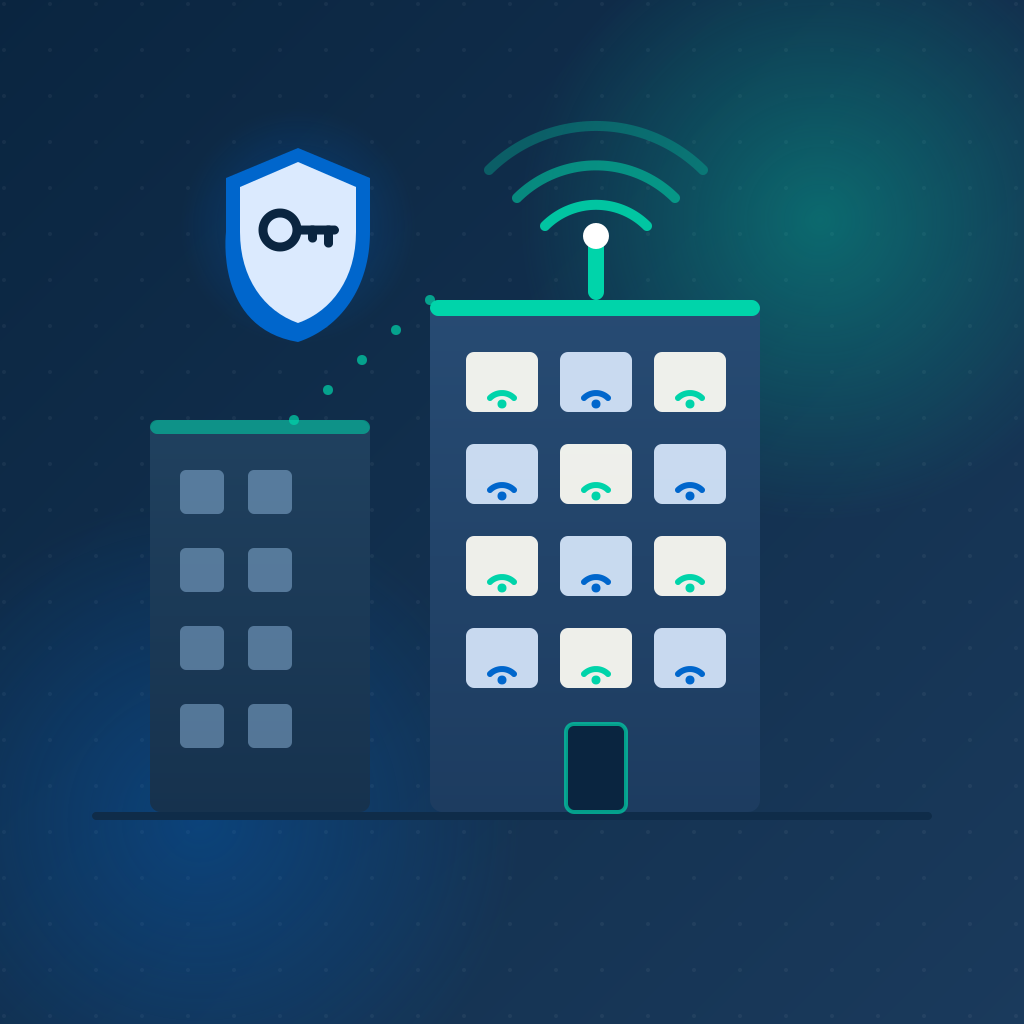
Modern MDU WiFi inverts the model: the property owns the access points and the backhaul, and identity - not cabling - separates the residents. Three building blocks make it work:
- Per-resident credentials instead of one shared secret. Each unit gets its own private key or its own 802.1X login. A leaked credential affects one unit and is revoked in one click - nobody else notices
- RADIUS-driven segmentation. When a device authenticates, a cloud RADIUS server tells the access point which VLAN or segment that identity belongs in. Every device a resident onboards lands in the same private segment: their TV, printer, and game console can see each other, and nobody else's
- Self-service onboarding. A captive portal or enrollment flow turns move-in day into a two-minute task: the resident signs in, gets their unit's credentials, and every subsequent device joins the same personal network
The result reads like a contradiction: hundreds of households on shared infrastructure, each experiencing a network that is theirs alone. Common areas ride the same system - a guest tier for visitors, full resident access in the gym and on the roof deck - without a second parallel build-out.
Where Do Passpoint and OpenRoaming Fit In?
Per-unit isolation solves security. Passpoint solves friction. A device provisioned once with a Passpoint profile authenticates automatically with WPA2/WPA3-Enterprise encryption everywhere the property broadcasts the network - no portal reappearing in the parking garage, no re-typing keys on the fifth floor. For residents it simply feels like their phone always has WiFi; for operators it means the connection is encrypted and attributable at every access point on the campus.
Two follow-on benefits matter in residential buildings specifically:
- WiFi calling where cellular gives up. Steel and concrete construction is hostile to mid-band cellular, and elevators and interior units are notorious dead zones. Seamless, always-on WiFi keeps voice calls flowing over the WLAN without residents thinking about it
- Roaming beyond the property. Operators that join an OpenRoaming federation let enrolled devices connect securely at thousands of other participating venues - a genuine perk for residents that costs the property almost nothing. Our OpenRoaming guide explains how the federation works
The industry is converging on exactly this architecture. The Wireless Broadband Alliance's Connectivity Strategies for Smart Multi-Dwelling Units report, released in February 2026, recommends fully managed, open-standards-based deployments - WPA3, Passpoint, and OpenRoaming among them - as the foundation for MDU connectivity that can scale securely instead of fragmenting into per-vendor islands.
How Do Move-Ins, Move-Outs, and Smart-Building IoT Stay Manageable?
An apartment building is a network with permanent churn: leases start and end every week. Identity-based WiFi turns that churn into a routine lifecycle instead of a standing headache:
- Provision on lease start. A unit's credentials are created when the lease begins - by the leasing team, or automatically via API from property-management software - so the network is live before the boxes arrive
- Revoke on move-out. Ending the lease ends the access. No building-wide password rotation, no lingering access for former residents
- Accountability per unit. Authentication logs tie network activity to a credential, which makes abuse complaints and troubleshooting tractable without inspecting anyone's traffic
The same identity layer handles the property's own devices. Smart locks, HVAC controllers, leak sensors, and cameras authenticate with their own device credentials onto segments that are walled off from every resident network - so a compromised gadget in the boiler room never becomes a neighbor problem. For the general pattern, see our guide to securing IoT devices on enterprise WiFi.
Building WiFi Into Your Property?
IronWiFi gives MDU operators per-unit private networks on shared infrastructure: RADIUS-driven segmentation, captive portal onboarding, Passpoint roaming, and lease-lifecycle credential management - on the access point hardware you already run.
Start Free Trial Explore MDU WiFiWhat Should Property Teams Look For in an MDU WiFi Platform?
If you're evaluating managed WiFi for a property or a portfolio, the architecture questions matter more than the brochure speeds:
- Identity, not shared secrets. Every resident and every property device should authenticate with a credential that can be issued and revoked individually
- Real per-unit isolation. Segmentation should be enforced by the authentication layer at every access point, not simulated with client-isolation checkboxes
- Portal and Passpoint together. A portal for easy first contact and guests; Passpoint profiles for the encrypted, zero-touch everyday experience
- Lifecycle automation. Credential creation and revocation should follow the lease via API, not a spreadsheet
- Vendor-neutral RADIUS. The identity layer should work with the enterprise access points you already own - and survive a future hardware refresh
- Visibility. Authentication logs and usage analytics per unit and per access point, for support calls and capacity planning alike
Conclusion
Renters have already voted: internet is a top-three amenity, and day-one availability is close to non-negotiable. The delivery models most buildings inherited - dozens of private ISP accounts or one shared password - can't meet that expectation securely, and bolting more access points onto either one doesn't fix the architecture.
Managed MDU WiFi does, by making identity the boundary: shared radios, private networks, credentials that follow the lease. Properties that get it right ship a better product on move-in day, retain residents an ISP handoff would have annoyed, and run one coherent network instead of a hundred accidental ones.
The standards are ready, the resident demand is measured, and the hardware you already own probably speaks RADIUS. What's left is the decision to treat WiFi like the amenity your residents already consider it to be.

Daniel Konecny
Blog Writer, IronWiFi
Daniel writes about enterprise WiFi authentication and identity security at IronWiFi. With deep expertise in RADIUS, 802.1X, and cloud infrastructure, he covers practical network security for IT teams managing thousands of devices.
About the author